It is hard to narrow down one definition of what it means to be digital. One way digital can be classified is by analyzing how many stages are options for the user. Infinite stages means something is analog, while digital has a finite number of values it can be. Some inventions and developments that use this concept can trace back to the beginning of written communication.
Hieroglyphs were images used before writing to explain stories. Early people used pictures to communicate, but the options of potential objects to draw were never ending. This means that hieroglyph symbols were analog. Eventually, consonant sounds were narrowed down, with only a finite number of sounds that can be produced by the human mouth. These sounds evolved over time to become our alphabet, with the Greeks having a large impact. Our alphabet was one of the first digital creations.
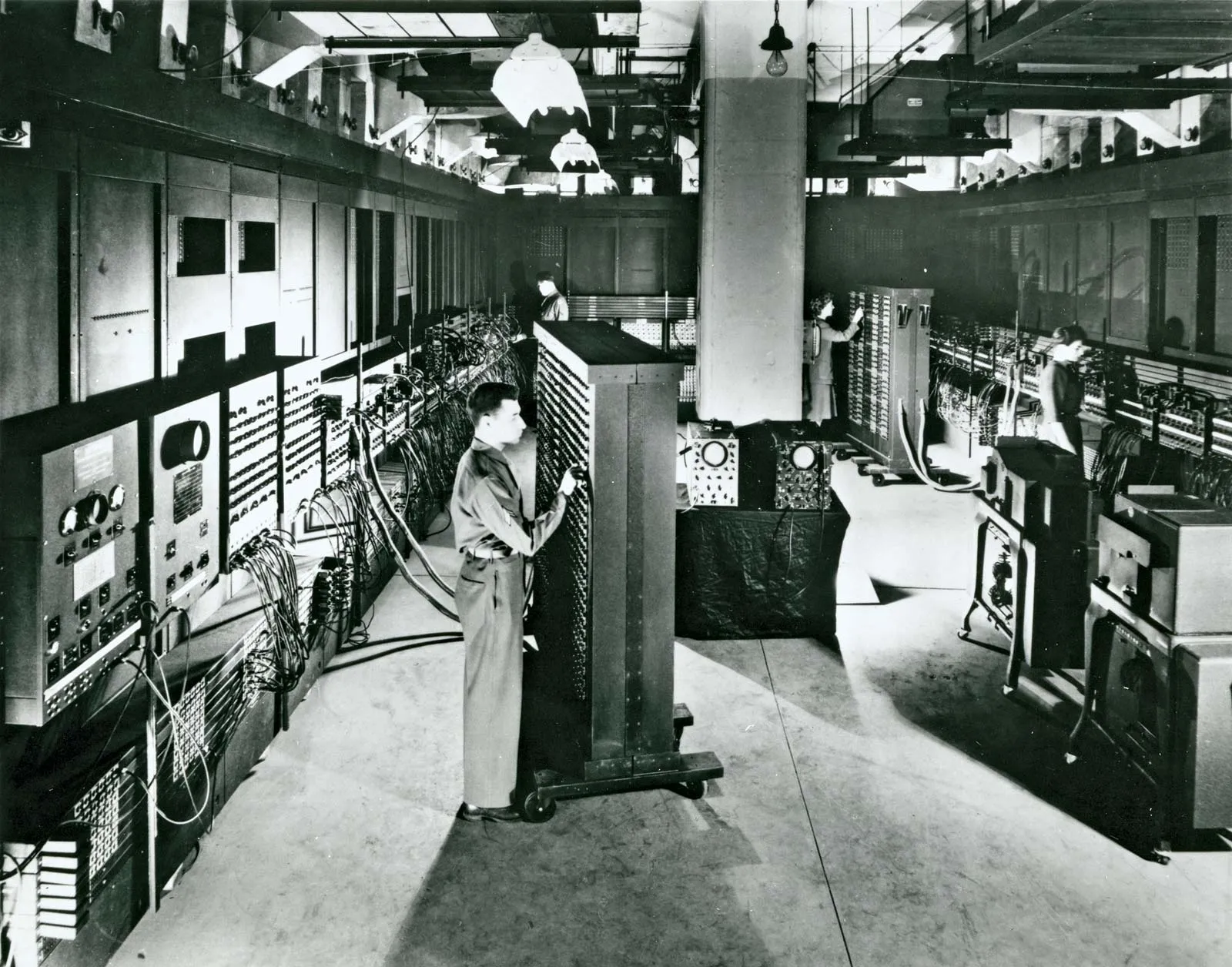
The digital revolution is considered to be in the 1950s. To begin the revolution, the Electronic Numerical Integrator and Calculator (ENIAC) (see right) was invented in the mid 1940s. It was a very large scale computer that was mostly used to perform complex mathematical problems. Computers became faster and smaller as time progressed, until the invention of personal computers.
ARPANET (Advanced Research Projects Agency Network) was developed and used in the late 1960s. It was the first packet-switched network, first developed for the government, and was the pioneer for the internet. The public World Wide Web was created in 1989.
Now, digital describes the way technology generates and processes data in terms of 1s and 0s. The 1 is considered a positive state, while the 0 is considered a nonpositive state. Data that is stored or transmitted digitally is expressed as a string of 1s and 0s (Yasar, 2023).
Digital was first created to push the limits of technology and help humans in their lives. However, the digital world we live in today has far surpassed its initial purposes.